
In 2017 Apprenticeships underwent an overhaul that aimed to create a new generation of apprenticeship programs tailored to industry needs. These reforms allowed employers more flexibility in designing training programs, ensuring that apprentices gain relevant skills that align with current job market demands. This shift has helped bridge the skills gap and enhance workforce readiness.
Apprenticeships can now be taken at a variety of levels, and in more industry sector areas than ever before, allowing employers to develop a skills workforce in line with their own needs, and in partnership with a good, local provider.
Finding the balance between formal learning and the opportunity to embed that within a workplace is essential to getting this right for both the Apprentice and employers. Here at South Hampshire College Group we pride ourselves on leading an employer responsive curriculum, meaning that we invite all employers to participate in employer group activity, give us feedback on our courses, as well as our delivery methods to make sure we're doing all we can to fully meet local employer needs. We regularly seek feedback and input from employers we are working with in terms of what's working well for them, as well as what they'd like to see us develop, so that we can make relevant changes in line with local needs. Our business development team is in place to work with employers to establish their needs; as we see it we're not here to 'sell you' our courses, but to listen and to understand your business needs so that we can advise you on the best fit to achieve your goals.
An Apprenticeship is a real job, meaning you take that person on as a member of your staff for at least the duration of their course. We understand this is a huge commitment, and it's important to get the right fit, so there are several ways we can help you to find the right person and ensure both your (and their) success.
The duration of an Apprenticeship depends on the chosen Apprenticeship Standard (subject) as well as the individual's prior learning and qualification. The minimum duration for any Apprenticeship is 12 months, although some are up to 5 years long. If your candidate already has some training or qualifications in place, it may be that the recommended duration can be shortened to reflect this prior learning, but this is not a guarantee as there are many factors to take into account. An individual assessment will take place for every candidate to ascertain whether a reduction in time on course (and associated funding cost) is appropriate, and this will be discussed at enrolment.
The basic stages are as shown in the diagram below, however you are not alone in these if you have a good provider. Here at SHCG we can support our employers at every stage, to the relevant level for their business needs and capacity, so do talk to us if you are unsure at any point.
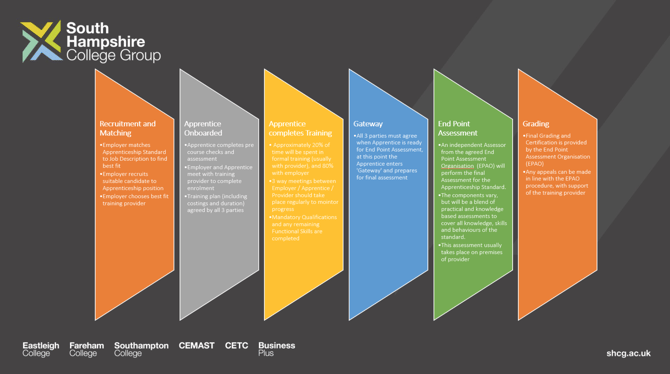
In essence, an Apprenticeship is still very much a real job. You can expect the formal training to be supported entirely by your chosen training provider, but the Apprentice will need top embed that learning with you. There are huge advantages to training new starters (or even existing staff) in this way, but we recognise it is not a good fit for every business.
One of the major concerns employers often approach us with is whether they have the expertise in their business to fully support and mentor the Apprentice during their 'employer based' hours. We recognise the challenge here, and have built a tailored pack of resources and support sessions for line managers too. It's just one of the ways we have developed and improved our employer support in recent months, and we will continue to tailor our support in line with your needs; all we ask is that you continue to tell us what they are!